.
The first Yokozuna-Tennis top 101 ranking of the open era was compiled right after Wimbledon 2008. Two grand slam tournaments have been played since,thus it is time to take another look.
Men’s Ranking
Dai-Yokozuna (great Grand Champion) Roger Federer (13 GS titles—4 finals—3 semifinals—2 quarterfinals) remains where he is, inspite of another grand slam title at the US Open and a lost final down under. Well, as the #2 of the open era he cannot be ranked much higher—only the great Rod Laver remains ahead of him. To pass season-grand-slam-winner Laver, Federer would need to win the French Open or close to 20 grand slam tournaments, both of which seems unlikely.
Just behind Federer follow the other two Dai-Yokozuna Pete Sampras and Bjorn Borg—Sampras because of Federer’s greater versatility across surfaces ad greater peak-dominance; Borg because of Federer’s larger number of GS titles. But I am well aware that these three could be ranked in any order.
The new Australian Open champion, Yokozuna (=Grand Champion) Rafael Nadal (6-2-2-2) moves up one rank to #13, just behind Stefan Edberg, and now ahead of John Newcombe... full article
Monday, February 2, 2009


Sunday, February 1, 2009
Sanyaku Ranks after the Australian Open 2009
.
The Sekiwake (= Junior Champions I) Dinara Safina and Elena Dementieva get promoted to Ozeki (= Champion), as a result of their consistent strong performances at the recent grand slam tournaments. For Dementieva this is a re-promotion to the rank she already held briefly in early 2005; but Safina becomes an Ozeki for the first time and is the 29th female Ozeki of the open era.
Other notable promotions are: former Ozeki Andy Roddick moves from Komusubi (= Junior Champion II) up to Sekiwake; while Fernando Verdasco, Juan Martin del Potro and Vera Zvonareva earn the first sanyaku (= championship) ranks of their careers at Komusubi. By contrast Andy Murray, Jelena Jankovic and Ana Ivanovic (a former Ozeki) lose Sekiwake rank and drop to Komusubi. Maria Sharapova (a long-time former Ozeki) and Patty Schnyder fall out of the sanyaku ranks alltogether.
The Yokozuna (= Grand Champions) -- Roger Federer, Rafael Nadal, Serena and Venus Williams -- keep their ranks, of course, as these are for life; Novak Djokovic remains Ozeki.
The full post 2009 Australian Open statisitcs, inclucing the complete new sankyaku line-up and the quarterfinal-through-final results, are published here.
The Sekiwake (= Junior Champions I) Dinara Safina and Elena Dementieva get promoted to Ozeki (= Champion), as a result of their consistent strong performances at the recent grand slam tournaments. For Dementieva this is a re-promotion to the rank she already held briefly in early 2005; but Safina becomes an Ozeki for the first time and is the 29th female Ozeki of the open era.
Other notable promotions are: former Ozeki Andy Roddick moves from Komusubi (= Junior Champion II) up to Sekiwake; while Fernando Verdasco, Juan Martin del Potro and Vera Zvonareva earn the first sanyaku (= championship) ranks of their careers at Komusubi. By contrast Andy Murray, Jelena Jankovic and Ana Ivanovic (a former Ozeki) lose Sekiwake rank and drop to Komusubi. Maria Sharapova (a long-time former Ozeki) and Patty Schnyder fall out of the sanyaku ranks alltogether.
The Yokozuna (= Grand Champions) -- Roger Federer, Rafael Nadal, Serena and Venus Williams -- keep their ranks, of course, as these are for life; Novak Djokovic remains Ozeki.
The full post 2009 Australian Open statisitcs, inclucing the complete new sankyaku line-up and the quarterfinal-through-final results, are published here.
Another One for the Ages
.
The two active Yokozuna of mens' tennis play another dramatic 5-set final, and the winner is again Nadal
 It does not get much better than this: for more than four hours Roger Federer (Y1E) and Rafael Nadal (Y1W) battled each other last night, with the momentum swinging several times, before Nadal finally imposed himself again and won the 6th grand slam title of his career -- the first on hardcourt. Federer's disappointment was only too visible in end. For a long time he looked more likely to win than his opponent, however: Federer had more chances to break serve (19-16), played more winners (71-50), even gained more points overall than Nadal (174-173) -- but in the end the brilliant Swiss fell again short when his game deteriorated markedly in the fifth set.
For Federer this is a setback in regaining the #1 spot and in equalling Pete Sampras record of 14 grand slam titles. It does not hurt him in my open era ratings though -- there he is already #2, ahead of fellow Dai-Yokozuna (=great Grand Champion) Sampras due to his greater versatility and peak dominance. To become #1 and bypass Rod Laver, Federer would have to either win the French Open or accumulate close to 20 grand slam titles -- both seems rather unlikely.
 It is to be hoped that Federer does not lose motivation after this renewed disappointment. Tennis needs Federer. It may be hard for him to regain the #1 spot, but I for my part have little doubt that on his day he still can beat Nadal. Moreover, he still tends to display more dominance vis-a-vis the other players than the Spaniard. Admittedly though, age does not play in his favor. Federer is 27, most great players start to lose consistency at this age.
Nadal moved up one place in my open era ratings and is now #13, just behind Boris Becker and Stefan Edberg and ahead of John Newcombe. But who would doubt that he could move up further soon, his possibly as early as at the upcoming French Open, a tournament he has dominated in the past four years. Given how similar career achievements are between #6 (Rosewall) and 13, Nadal may well be the open era #6 in a year or two.
Fortunately for us, Nadal is still only 22 years old and could have many more years at the top ahead of him -- if his body continues to support his immensly physical game.
The two active Yokozuna of mens' tennis play another dramatic 5-set final, and the winner is again Nadal
 It does not get much better than this: for more than four hours Roger Federer (Y1E) and Rafael Nadal (Y1W) battled each other last night, with the momentum swinging several times, before Nadal finally imposed himself again and won the 6th grand slam title of his career -- the first on hardcourt. Federer's disappointment was only too visible in end. For a long time he looked more likely to win than his opponent, however: Federer had more chances to break serve (19-16), played more winners (71-50), even gained more points overall than Nadal (174-173) -- but in the end the brilliant Swiss fell again short when his game deteriorated markedly in the fifth set.
 For Federer this is a setback in regaining the #1 spot and in equalling Pete Sampras record of 14 grand slam titles. It does not hurt him in my open era ratings though -- there he is already #2, ahead of fellow Dai-Yokozuna (=great Grand Champion) Sampras due to his greater versatility and peak dominance. To become #1 and bypass Rod Laver, Federer would have to either win the French Open or accumulate close to 20 grand slam titles -- both seems rather unlikely.
 It is to be hoped that Federer does not lose motivation after this renewed disappointment. Tennis needs Federer. It may be hard for him to regain the #1 spot, but I for my part have little doubt that on his day he still can beat Nadal. Moreover, he still tends to display more dominance vis-a-vis the other players than the Spaniard. Admittedly though, age does not play in his favor. Federer is 27, most great players start to lose consistency at this age.
Nadal moved up one place in my open era ratings and is now #13, just behind Boris Becker and Stefan Edberg and ahead of John Newcombe. But who would doubt that he could move up further soon, his possibly as early as at the upcoming French Open, a tournament he has dominated in the past four years. Given how similar career achievements are between #6 (Rosewall) and 13, Nadal may well be the open era #6 in a year or two.
Fortunately for us, Nadal is still only 22 years old and could have many more years at the top ahead of him -- if his body continues to support his immensly physical game.
Saturday, January 31, 2009
Magnificent Serena
.
Serena Williams is the 7th female Dai-Yokozuna of the open era.
 Last night Serena Williams won the 2009 Australian Open in sytle, blasting past the brave but overmatched Dinara Safina, who will be promoted from Sekiwake (=Junior Champion I) to Ozeki (Champion) after this tournament. This is Serena's 10th Grand Slam title. In Ozumo, 10 titles is commonly seen as the threshold for a Yokozuna (=Grand Champion) to be considered "Dai" -- i.e., "great".
Dai-Yokozuna is not a rank (like Yokozuna or Ozeki) but an honorary title. Thus far in the open era, only seven female tennis players have earned this attribute:
(1) Margaret Court, whose 24 grand slam titles (between 1960 and 1973) are still the record, 11 of them in the open era;
(2) Court's great rival Billie Jean King (12 grand slams 1966-1975, 8 of them in the open era);
(3) Chris Evert (18 slams, 1974-1986),
(4) Martina Navratilova (18 slams, 1978-1990);
(5) Steffi Graf (22 slams, 1987-1999);
(6) Monica Seles (9 slams, 1990-1996); and now
(7) Serena Williams (10 slams, 1999-2009).
Seles falls one short of the common threshold but is considered a Dai-Yokozuna nonetheless, given that her career was interrupted by a violent attack from a deranged fan that cost Seles several years of her career.
And now there is Serena. Serena started her Grand Slam career in 1998 at age 16, one year after her older sister, fellow Yokozuna Venus Williams. Her first great success came at end-1999 when she won the US Open, beating three Yokozuna on the way to the title: Monica Seles, Lindsay Davenport and Martina Hingis and earning an immediate promotion to Sekiwake. Serena then stayed at lower sanyaku level for the next 2 1/2 years, until she suddenly exploded in 2002, winning 4 grand slam titles in a row, starting with the French Open. No player since Steffi Graf in 1993/94 had achieved this feat, and no player has since. 2002 also saw Serena's promotion to Ozeki and then Yokozuna, as well as her first world #1 ranking, inherited from Venus.
Serena's career had her setbacks. From 2003 chronic knee injuries made her miss several grand slam tournaments or play them with insufficient preparation. By 2006, she was not considered an active Yokozuna any longer, as she had not reached a grand slam quarterfinal in more than a year, i.e. since her victory at the Australian Open of 2005. Other players, like Yokozuna Justine Henin or Ozeki Maria Sharapova, took over as the sport's leading competitors.
Serena burst back onto the scene by winning the Australian Open 2007 out of the blue, beating Sharapova in the final, but resumed her former domination in full only in 2008, when she reached the Wimbledon final (losing to Venus) and now won back-to-back the US and the Australian Open.
In my open era player rankings I keep Serena at #7 for now, behind her six fellow Dai-Yokozuna. But two more grand slam titles and Serena would overtake King and Seles and move to #5. Given how Serena has performed recently, there is little doubt she could achieve also this. Only Court, Graf, Navratilova and Evert would then remain ahead of her (that are probably out of reach).
For Serena's full career record see here (to come).
Serena Williams is the 7th female Dai-Yokozuna of the open era.
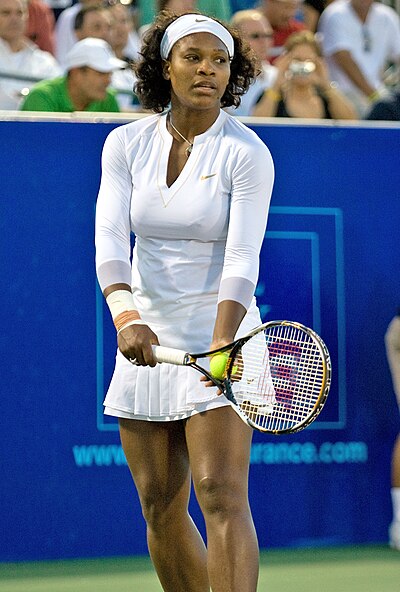 Last night Serena Williams won the 2009 Australian Open in sytle, blasting past the brave but overmatched Dinara Safina, who will be promoted from Sekiwake (=Junior Champion I) to Ozeki (Champion) after this tournament. This is Serena's 10th Grand Slam title. In Ozumo, 10 titles is commonly seen as the threshold for a Yokozuna (=Grand Champion) to be considered "Dai" -- i.e., "great".
Dai-Yokozuna is not a rank (like Yokozuna or Ozeki) but an honorary title. Thus far in the open era, only seven female tennis players have earned this attribute:
(1) Margaret Court, whose 24 grand slam titles (between 1960 and 1973) are still the record, 11 of them in the open era;
(2) Court's great rival Billie Jean King (12 grand slams 1966-1975, 8 of them in the open era);
(3) Chris Evert (18 slams, 1974-1986),
(4) Martina Navratilova (18 slams, 1978-1990);
(5) Steffi Graf (22 slams, 1987-1999);
(6) Monica Seles (9 slams, 1990-1996); and now
(7) Serena Williams (10 slams, 1999-2009).
Seles falls one short of the common threshold but is considered a Dai-Yokozuna nonetheless, given that her career was interrupted by a violent attack from a deranged fan that cost Seles several years of her career.
And now there is Serena. Serena started her Grand Slam career in 1998 at age 16, one year after her older sister, fellow Yokozuna Venus Williams. Her first great success came at end-1999 when she won the US Open, beating three Yokozuna on the way to the title: Monica Seles, Lindsay Davenport and Martina Hingis and earning an immediate promotion to Sekiwake. Serena then stayed at lower sanyaku level for the next 2 1/2 years, until she suddenly exploded in 2002, winning 4 grand slam titles in a row, starting with the French Open. No player since Steffi Graf in 1993/94 had achieved this feat, and no player has since. 2002 also saw Serena's promotion to Ozeki and then Yokozuna, as well as her first world #1 ranking, inherited from Venus.
Serena's career had her setbacks. From 2003 chronic knee injuries made her miss several grand slam tournaments or play them with insufficient preparation. By 2006, she was not considered an active Yokozuna any longer, as she had not reached a grand slam quarterfinal in more than a year, i.e. since her victory at the Australian Open of 2005. Other players, like Yokozuna Justine Henin or Ozeki Maria Sharapova, took over as the sport's leading competitors.
Serena burst back onto the scene by winning the Australian Open 2007 out of the blue, beating Sharapova in the final, but resumed her former domination in full only in 2008, when she reached the Wimbledon final (losing to Venus) and now won back-to-back the US and the Australian Open.
In my open era player rankings I keep Serena at #7 for now, behind her six fellow Dai-Yokozuna. But two more grand slam titles and Serena would overtake King and Seles and move to #5. Given how Serena has performed recently, there is little doubt she could achieve also this. Only Court, Graf, Navratilova and Evert would then remain ahead of her (that are probably out of reach).
For Serena's full career record see here (to come).
Friday, January 30, 2009
An All-Yokozuna Mens' Final
.
Rafael Nadal followed his fellow Yokozuna (=Grand Champion) Roger Federer into the Australian Open final by wrestling his compatriot M5E Fernando Verdasco to defeat in five gruelling and gripping sets.
 This is the 7th time Federer and Nadal meet in a Grand Slam final, but the first time for both to meet as Yozokuna. The last all-Yokozuna Grand Slam final was at the 2005 US Open, when Federer beat Andre Agassi in four sets.
It's hard to make out a clear favorite: while Nadal leads Federer 12-6 head-to-head (5-2 at slams), he trails Federer 2-3 on hard court, and Federer's record at the Australian Open is much better. Plus, Federer has looked awesome at these Open even since he overcame M8W Tomas Berdych in a tight five-setter in round 4.
Verdasco (picture) earns a career-first promotion to Komusubi (=Junior Champion II) for his heroics, joining Andy Murray -- demoted from Sekiwake (=Junior Champion I) -- and fellow first-time Komusubi Juan Martin del Potro at this rank. The other failed semi-finalist, former Ozeki (=Champion) Andy Roddick, who fell in three entertaining sets to Federer, moves up one rank from Komusubi to Sekiwake.
After the Australian Open, the mens' sanyaku-line-up will therefore be as follows:
Yokozuna: Federer, Nadal
Ozeki: Djokovic
Sekiwake: Roddick (up from K)
Komusubi: Murray (down from S), del Potro (up from M2), Verdasco (up from M5).
Rafael Nadal followed his fellow Yokozuna (=Grand Champion) Roger Federer into the Australian Open final by wrestling his compatriot M5E Fernando Verdasco to defeat in five gruelling and gripping sets.
 This is the 7th time Federer and Nadal meet in a Grand Slam final, but the first time for both to meet as Yozokuna. The last all-Yokozuna Grand Slam final was at the 2005 US Open, when Federer beat Andre Agassi in four sets.
 It's hard to make out a clear favorite: while Nadal leads Federer 12-6 head-to-head (5-2 at slams), he trails Federer 2-3 on hard court, and Federer's record at the Australian Open is much better. Plus, Federer has looked awesome at these Open even since he overcame M8W Tomas Berdych in a tight five-setter in round 4.
Verdasco (picture) earns a career-first promotion to Komusubi (=Junior Champion II) for his heroics, joining Andy Murray -- demoted from Sekiwake (=Junior Champion I) -- and fellow first-time Komusubi Juan Martin del Potro at this rank. The other failed semi-finalist, former Ozeki (=Champion) Andy Roddick, who fell in three entertaining sets to Federer, moves up one rank from Komusubi to Sekiwake.
After the Australian Open, the mens' sanyaku-line-up will therefore be as follows:
Yokozuna: Federer, Nadal
Ozeki: Djokovic
Sekiwake: Roddick (up from K)
Komusubi: Murray (down from S), del Potro (up from M2), Verdasco (up from M5).
Safina Follows Dementieva to Ozeki; Serena One Win Away from Dai-Yokozuna Status
.
Something rather unusual happened in the ladies' game: two promtions to Ozeki (=Champion) in one tournament. Elena Dementieva secured her Ozeki re-promotion by entering the third consecutive GS semifinal, even though she lost the semi to Yokozuna (=Grand Champion) Serena Williams, who saved her best tennis for this match (Dementieva had already been an Ozeki in 2004/05).
 Now Dinara Safina has made the same step, overcoming her compatriot Vera Zvonareva in the semifinals. This plus Safinas semifinal participation at the US Open fulfills the promotion requirements to Ozeki. Safina has therefore reached the same career-high rank as her charismatic elder brother, two-time grand slam winner Marat Safin.
Ozeki promotions are rare enough -- Safina will be the 29th female Ozeki of the open era (along side 27 male career-high Ozeki) -- but double-Ozeki promotions are extremely rare. In the ladies' game it has happened only once right at the beginning of the open era, when Anne Haydon-Jones and Nancy Richey made it to Ozeki at the Wimbledon tournament of 1968. In mens' open era tennis, the only double promotion has been Gustavo Kuerten's and Magnus Norman's at the French Open of 2000.
The majority of Ozeki have won one (14 female/11 male players) or more (5 female/12 male players) grand slam titles in their careers. It is to be hoped that Dementieva and Safina can live up to this standard. Safina will have an opportunity tonight when she battles the magnificent Serena Williams.
Should Safina fail at this occasion, something out of the ordinary would happen: Serena would win her 10th grand slam title, which is the common threshold for being considered a Dai-Yokozuna (great Grand Champion). Since the beginning of the open era, only six female and four male Dai-Yokozuna have been recognized as Dai-Yokozuna: Margaret Court, Billie Jean King, Chris Evert, Martina Navratilova, Steffi Graf, Monica Seles; Rod Laver, Bjorn Borg, Pete Sampras, and Roger Federer. Serena would join an outstanding elite group indeed.
Finally, the post-Australian Open ladies' sanyaku line-up is set:
Yokozuna: S. Williams, V. Williams
Ozeki: Safina (up from S), Dementieva (up from S)
Sekiwake: none
Komusubi: Jankovic (down from S), Ivanovic (down from S), Zvonareva (up from M1).
Demoted from Komusubi to Maegashira: Sharapova, Schnyder.
Something rather unusual happened in the ladies' game: two promtions to Ozeki (=Champion) in one tournament. Elena Dementieva secured her Ozeki re-promotion by entering the third consecutive GS semifinal, even though she lost the semi to Yokozuna (=Grand Champion) Serena Williams, who saved her best tennis for this match (Dementieva had already been an Ozeki in 2004/05).
 Now Dinara Safina has made the same step, overcoming her compatriot Vera Zvonareva in the semifinals. This plus Safinas semifinal participation at the US Open fulfills the promotion requirements to Ozeki. Safina has therefore reached the same career-high rank as her charismatic elder brother, two-time grand slam winner Marat Safin.
Ozeki promotions are rare enough -- Safina will be the 29th female Ozeki of the open era (along side 27 male career-high Ozeki) -- but double-Ozeki promotions are extremely rare. In the ladies' game it has happened only once right at the beginning of the open era, when Anne Haydon-Jones and Nancy Richey made it to Ozeki at the Wimbledon tournament of 1968. In mens' open era tennis, the only double promotion has been Gustavo Kuerten's and Magnus Norman's at the French Open of 2000.
The majority of Ozeki have won one (14 female/11 male players) or more (5 female/12 male players) grand slam titles in their careers. It is to be hoped that Dementieva and Safina can live up to this standard. Safina will have an opportunity tonight when she battles the magnificent Serena Williams.
Should Safina fail at this occasion, something out of the ordinary would happen: Serena would win her 10th grand slam title, which is the common threshold for being considered a Dai-Yokozuna (great Grand Champion). Since the beginning of the open era, only six female and four male Dai-Yokozuna have been recognized as Dai-Yokozuna: Margaret Court, Billie Jean King, Chris Evert, Martina Navratilova, Steffi Graf, Monica Seles; Rod Laver, Bjorn Borg, Pete Sampras, and Roger Federer. Serena would join an outstanding elite group indeed.
Finally, the post-Australian Open ladies' sanyaku line-up is set:
Yokozuna: S. Williams, V. Williams
Ozeki: Safina (up from S), Dementieva (up from S)
Sekiwake: none
Komusubi: Jankovic (down from S), Ivanovic (down from S), Zvonareva (up from M1).
Demoted from Komusubi to Maegashira: Sharapova, Schnyder.
Subscribe to:
Posts (Atom)